SEND
Swavesey Primary School
SEND information report 2025-26.
Special Educational Needs and Disabilities Coordinator (SENDCO): Laura McAuley
At Swavesey Primary school, we pride ourselves on being as inclusive as possible. We are committed to giving all our children every opportunity to achieve their best. The achievement, attitude and well-being of every child matters and inclusion is the responsibility of all within our school.
Definition of SEN and Disability (SEND)
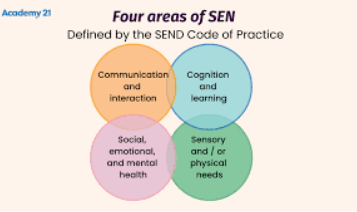
A child has SEND if they have a learning difficulty or disability that calls for special educational provision to be made for them. There are four main areas of SEND:
The SEND Code of Practice (2014) states: ‘A child or young person has special educational needs if he or she has a learning difficulty or disability which calls for special educational provision to be made for him or her. A learning difficulty or disability is a significantly greater difficulty in learning than the majority of others of the same age. Special educational provision means educational or training provision that is additional to, or different from, that made generally for others of the same age in a mainstream setting in England.
Disability: Many children and young people who have SEN may have a disability under the Equality Act 2010 – that is ‘…a physical or mental impairment which has a long-term and substantial adverse effect on their ability to carry out normal day-to-day activities.’
Cambridgeshire Local Offer
All local authorities working with their partners must publish information about how children and young people 0 - 25 who have special educational needs and/or disabilities (SEND) are supported in their area. This is known as the local offer. The local offer includes information on:
- universal services that are available to everyone, such as schools, GPs, (universal services)
- targeted support and services for children and young people who may need some additional, short term support
- specialist services for children and young people who have complex needs and need longer-term specialised support
The intention of the Local Offer is to improve choice and transparency for families. It will also be an important resource for parents in understanding the range of services and provision in the local area.
Click here for the LA local offer.
What is the Special Education Needs Information Report?
The Special Education Needs Information Report
Schools utilise the LA Local Offer to meet the needs of pupils with SEND as determined by school policy and the provision that the school is able to provide. Schools refer to this as ‘The Special Education Needs Information Report.
Special Educational Needs and Disabilities (SEND) – School offer
Introduction
We are a mainstream village primary school of about 313 pupils aged 4 -11 years, with a Section 27 preschool setting of approximate 50 children.
Most of our classes are mixed year groups, and we have around 30 children in each class, although our KS2 classes regularly are 30+. Our school provides a broad, challenging and practical curriculum within a warm, stimulating and imaginative environment to enable our children to enjoy their learning, as well as, develop the skills, attitudes and knowledge to become lifelong learners and achieve their full potential.
For more information please see our website www.swavesey.cambs.sch.uk
| % SEND | 2025-26: Pupils with SEND 21% | |
|---|---|---|
|
Accessibility |
Wheelchair access throughout. Disabled toilets. |
|
|
Associated policies |
Special Educational Needs and Disabilities Policy Children with Medical Needs Policy Equality, Equity & Diversity Policy Intimate Care Policy Management of Sickness absences Policy Positive Behaviour Policy Attendance Policy Anti-Bullying Policy Code of Conduct Policy |
Click here access details about the Cambridgeshire County Council SEND Local Offer. |
| Range of provision for Graduated Approach | ||
| Universal provision for ALL pupils | Targeted support for some pupils identified as needing help to achieve good progress |
Personalised provision for pupils with Special Educational Needs or Disabilities |
|
Quality first teaching, including well differentiated work to match the needs of ALL learners; accurate assessment and effective feedback.
Termly achievement tracking and pupil targets ensures high expectations for all, identifies those in need of targeted support and ensures resources are effectively deployed.
Termly achievement tracking and pupil targets ensures high expectations for all, identifies those in need of targeted support and ensures resources are effectively deployed.
Involvement & inclusion of learners, through engaging learning contexts; explicit learning about learning; encouragement of pupil voice. Every effort will be made for ALL learners to take part in the activities of the school together. |
In-class support, given by teacher or teaching assistant during specific lessons. Intervention groups, led by the class teacher or trained teaching assistant, with the aim of making accelerated progress over a set amount of time. Usually focused on reading, writing or maths. Sensory circuits with trained TAs, SENDCo or a Higher Level Teaching Assistant. Lego therapy clubs To encourage turn taking, dexterity, giving and following instructions. Social skills groups Led by teaching assistants or SENDCo to help children know how to cope in different situations. Speech therapy groups Initial input by a trained speech and language therapist (SALT), follow up sessions for individuals or in small school groups. SALT advice for parents. |
SENCO Laura McAuley is our Special Educational Needs and Disabilities Co-ordinator (SENDCo). She has weekly release time for monitoring, liaison and administration of SEND provision. We also have the opportunity to take small groups into ‘The Snug’ for extra sessions to support pupils with social communication skills; emotional health and wellbeing. Liaison with specialist agencies eg, speech & lang., educational psychologist (EP), occupational health, physiotherapist, family support worker, counsellor. Additional involvement of parents / carers, in identifying, meeting and reviewing the needs of their child(ren). Education, Health & Care Plans (EHCPs) in line with the SEND Code of Practice: 0 – 25 years January 2015 and Equalities act 2010, ensure that, “we will make reasonable adjustments for disabled children to help alleviate any substantial disadvantage they experience because of their disability, and will not discriminate against or harass them.” An EHC Plan is created in consultation with the pupil, parents and professionals. It details the specific strategies, support, resources and targets in place for the child and is reviewed annually. |
|
Graduated approach for identifying and addressing an individual’s needs |
|||
|
Assess |
Plan |
Do |
Review |
|
|
|
|
|
Interventions regularly used |
Reading & Writing: Precision teaching of reading; Little Wandle phonics catch up intervention groups; Switch on. Maths: 1st Class @ Number, Success@arithmetic Other: Sensory circuits; Speech therapy; Lego Therapy; Social skills; 'Time to talk', Socially speaking, Incredible 5 point scale, Book of Beasties club, Drawing and Talking. This is not an exhaustive list, but gives examples of interventions most commonly used and in which staff are trained. In consultation with other agencies we will always seek the most effective interventions for the individual in question. Individual children’s progress during interventions is closely monitored. |
|
Parent / carer engagement |
We welcome parental involvement, especially in planning for and meeting the needs of children with SEND. Parents & carers are often asked to attend meetings with outside agencies. Teachers, SENDCO and/or senior leaders are happy to meet with families regularly and when necessary to review and improve individual provision. Any concerns or complaints should be communicated to the Headteacher as soon as possible. |
|
Contact details |
SENDCo: Miss Laura McAuley Headteacher: Lynsey Ogilvie Contact via the school office: 01954 273312 office@swavesey.cambs.sch.uk
|
|
Date |
September 2025 |
Questions
Please read the questions below and click on their links for more information about the Special Education Needs Information Report for Swavesey Primary School.
- Who are the best people to talk to in this school about my child’s difficulties with learning / Special Educational Needs or Disability (SEND)?
- What are the different types of support available for children with SEND in our school?
- How can I let the school know that I am concerned about my child’s progress in school?
- How will the school let me know if they have any concerns about my child’s learning in school?
- How is extra support allocated to children, and how do they progress in their learning?
- Who are the other people providing services to children with SEND in this school?
- How are the teachers in school helped to work with children with SEND, and what training do the teachers have?
- How will the teaching be adapted for my child with SEND?
- How will we measure the progress of your child in school?
- What support do we have for you as a parent of a child with SEND?
- How is Swavesey Primary school accessible to children with SEND?
- How will we support your child when they are joining this school? Leaving this school? Or moving to another class?
- How will we support your child’s emotional and social development?
- What school Policies are there for making provision for pupils with special educational needs?
- Click here for some useful SEND links.